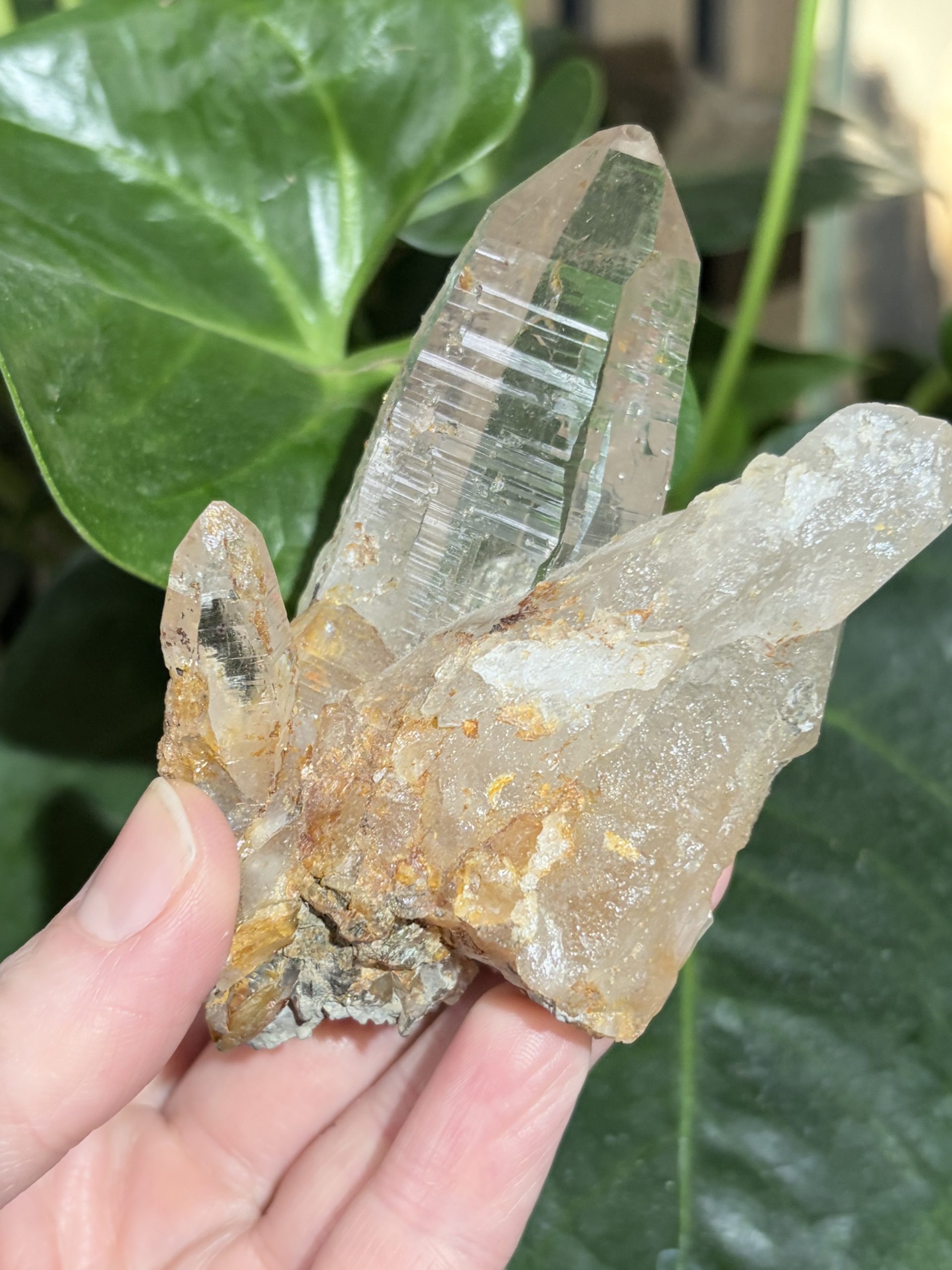
Himalayan quartz is often regarded as one of the most revered forms of clear quartz — shaped in some of the planet’s youngest and most dramatic mountain ranges. Many specimens are still hand-mined in remote regions, sometimes carried down on foot, which adds to their mystique among collectors and practitioners.
Let’s explore what distinguishes this crystal.
Geological / Physical Properties
-
Mineral: Silicon dioxide (clear quartz family).
-
Typical appearance: Clear to milky, frequently with internal fractures, veils, or mineral inclusions.
-
Common inclusions: Iron (giving golden or reddish tones), chlorite, hematite, and occasionally rainbows.
-
Hardness: 7 on the Mohs scale.
-
Formation environment: Extreme pressure, tectonic uplift, and glacial conditions contribute to their often complex internal structures.
A defining feature:
Unlike very polished-looking quartz from commercial mines, Himalayan crystals often retain a wild, untouched geometry — a visual reminder of their rugged origin.
Traditional Energetic Associations
(Spiritual interpretations rather than scientific claims.)
Strong but शांत (steady) presence
Many describe Himalayan quartz as powerful yet deeply calm — less “amplifying noise,” more amplifying stillness.
Meditation support
Frequently used as a focal stone because practitioners feel it encourages:
-
spacious awareness
-
mental quiet
-
sustained attention
Integration of higher insight
Symbolically linked with bringing expanded perception into embodied understanding — insight that can actually be lived.
Field clearing
Often placed in healing rooms to create a sense of clarity without sharpness.
Teacher-like quality
Some collectors say these crystals feel less like tools and more like companions for long inner work.